

In salary cap sports leagues, teams can only spend a certain amount of money per season on players. Better players often command more money and can price themselves out of a team’s budget. This creates the need for teams to place a dollar value on players as a percentage of the salary cap. Teams that can sign players to “team-friendly” contracts (in other words, contracts that are below market value for what the player provides and thus provide excess value to the team) often are more successful in salary cap leagues. NFL running backs (RBs) have traditionally been evaluated based off rushing output (rushing yards, rushing touchdowns, rushing expected points added [EPA], etc.). However, in the modern, pass-heavy NFL, RBs are now also evaluated off their passing output (receiving touchdowns, targets, etc.).
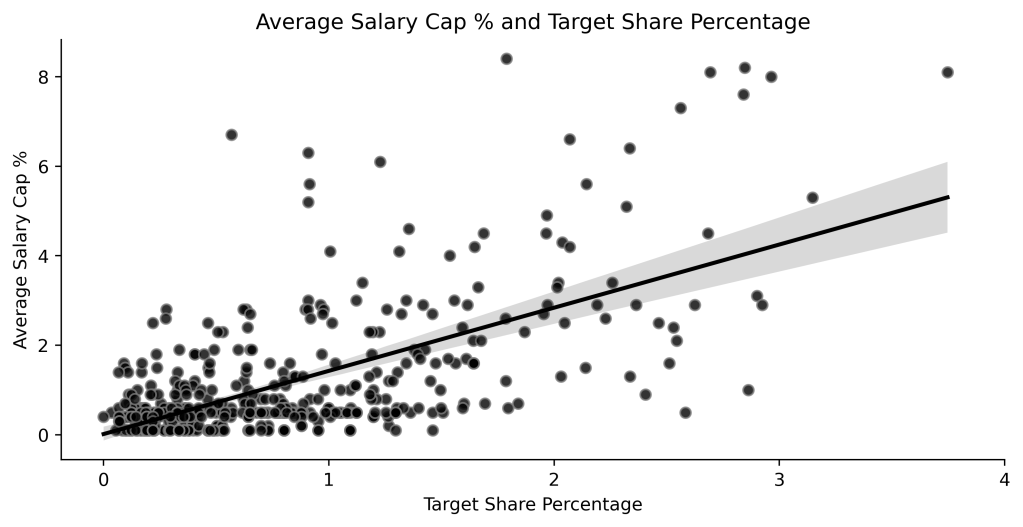
The purpose of this analysis was to develop a linear regression model to predict new RB contracts’ average salary cap percentage (CapAPY) based off their contract year (defined as the last season of their old contract) statistics. It was hypothesized that Rushing EPA and Total Touchdowns would be significant predictors of CapAPY. Prior to developing the model, I looked at some scatterplots to ensure there would be a relationship between the selected statistics and CapAPY. Ultimately, the selected inputs to the model were Rushing EPA, Rushing First Downs, Target Share %, Receiving EPA, and Total Touchdowns. The Target Share % figure is presented below.
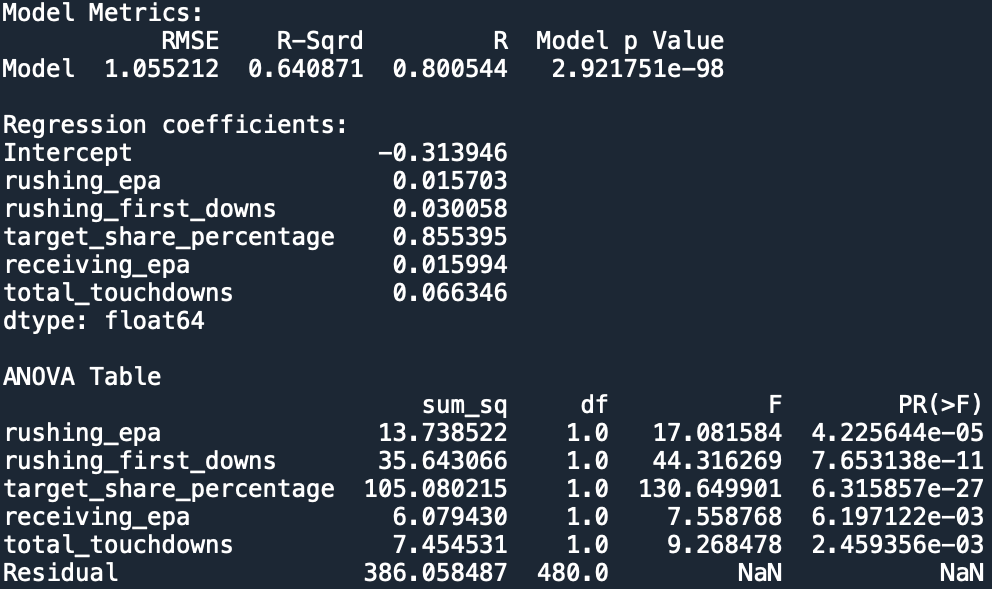
The model was significant and able to predict new contract CapAPY. The model metrics can be seen below. The R2 value of 0.64 illustrates that my model explained 64% of the variance and was overall statistically significant (p < 0.05). Regression coefficients (seen below) illustrate the slope of the line for each predictor variable when plotted against CapAPY (for example, a 1% increase in target share is associated with a 0.86% increase in CapAPY). While Rushing EPA and Total Touchdowns during the contract year were significant predictors, their regression coefficients paled in comparison to Target Share. Additionally, Receiving EPA was also a significant predictor and had an identical regression coefficient to Rushing EPA. These results demonstrate that RBs who have greater passing-game outputs are more valuable to teams than RBs who only contribute to the running-game. Interestingly, age was not found to be a significant predictor of CapAPY and when it was included, the evaluation metrics all decreased. It was hypothesized that age may have a quadratic relationship with CapAPY because NFL players’ rookie contracts (first contract in the league) are far below market value and their second contract is often their largest contract before subsequent contracts begin to decrease in value. However, after squaring age and adding that to the model, age was still not a significant predictor of CapAPY and decreased the efficacy of the model. Future work should look at how these trends change(d) over time.
 Joshua Taylor
Leave a comment